

- 评估检索步骤,以确保根据输入查询检索到正确的文档。
- 评估生成步骤,以确保根据检索到的文档生成正确的答案。
1. 定义你的 LLM 管道
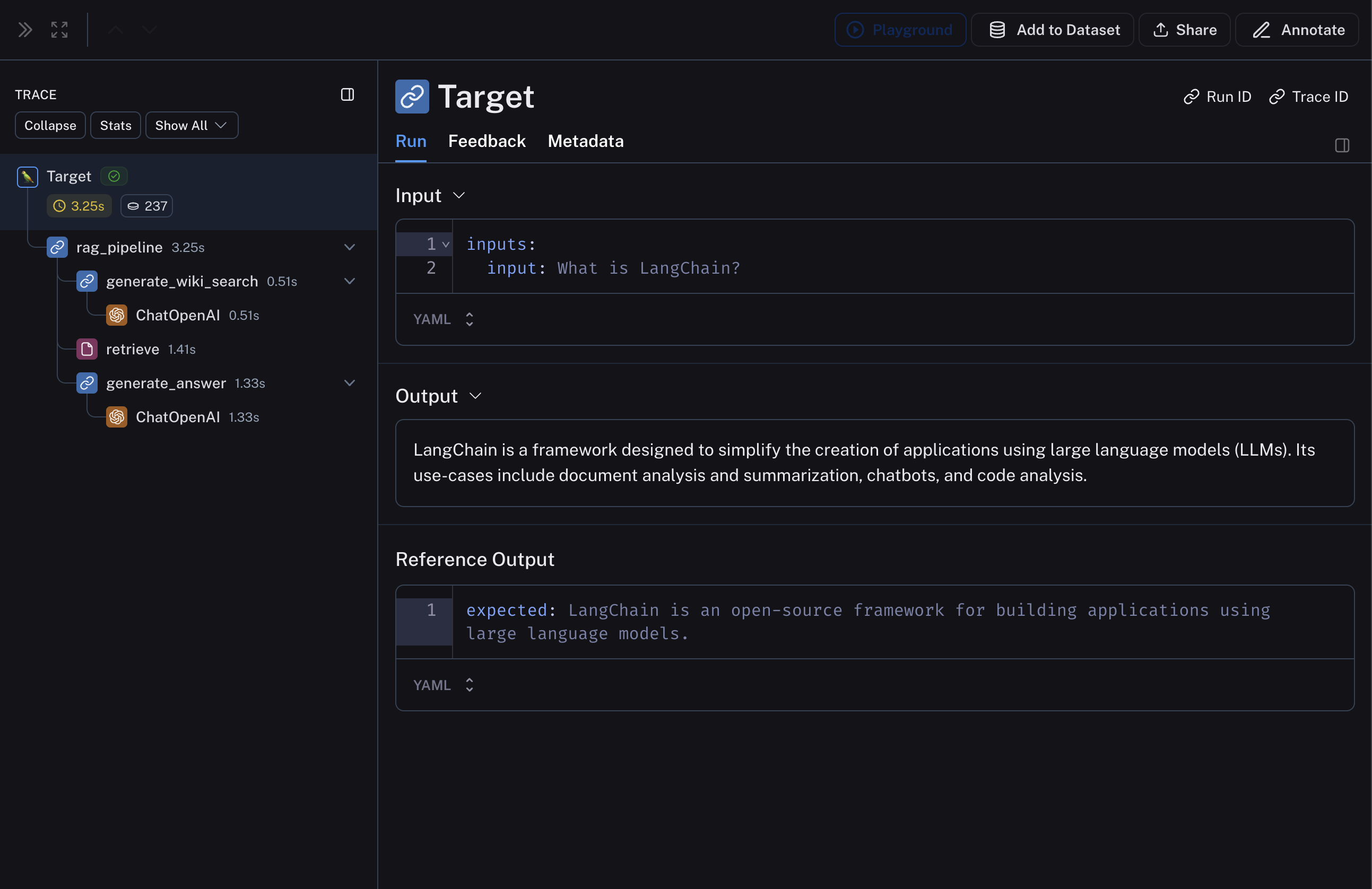
下面的 RAG 管道包括 1) 根据输入问题生成维基百科查询,2) 从维基百科检索相关文档,以及 3) 根据检索到的文档生成答案。复制
向 AI 提问
pip install -U langsmith langchain[openai] wikipedia
langsmith>=0.3.13
复制
向 AI 提问
import wikipedia as wp
from openai import OpenAI
from langsmith import traceable, wrappers

oai_client = wrappers.wrap_openai(OpenAI())

@traceable
def generate_wiki_search(question: str) -> str:
    """Generate the query to search in wikipedia."""
    instructions = (
        "Generate a search query to pass into wikipedia to answer the user's question. "
        "Return only the search query and nothing more. "
        "This will passed in directly to the wikipedia search engine."
    )
    messages = [
        {"role": "system", "content": instructions},
        {"role": "user", "content": question}
    ]
    result = oai_client.chat.completions.create(
        messages=messages,
        model="gpt-4o-mini",
        temperature=0,
    )
    return result.choices[0].message.content

@traceable(run_type="retriever")
def retrieve(query: str) -> list:
    """Get up to two search wikipedia results."""
    results = []
    for term in wp.search(query, results = 10):
        try:
            page = wp.page(term, auto_suggest=False)
            results.append({
                "page_content": page.summary,
                "type": "Document",
                "metadata": {"url": page.url}
            })
        except wp.DisambiguationError:
            pass
        if len(results) >= 2:
            return results

@traceable
def generate_answer(question: str, context: str) -> str:
    """Answer the question based on the retrieved information."""
    instructions = f"Answer the user's question based ONLY on the content below:\n\n{context}"
    messages = [
        {"role": "system", "content": instructions},
        {"role": "user", "content": question}
    ]
    result = oai_client.chat.completions.create(
        messages=messages,
        model="gpt-4o-mini",
        temperature=0
    )
    return result.choices[0].message.content

@traceable
def qa_pipeline(question: str) -> str:
    """The full pipeline."""
    query = generate_wiki_search(question)
    context = "\n\n".join([doc["page_content"] for doc in retrieve(query)])
    return generate_answer(question, context)
2. 创建一个数据集和示例来评估管道
我们正在构建一个非常简单的数据集,其中包含几个示例来评估管道。 需要 `langsmith>=0.3.13`复制
向 AI 提问
from langsmith import Client

ls_client = Client()
dataset_name = "Wikipedia RAG"

if not ls_client.has_dataset(dataset_name=dataset_name):
    dataset = ls_client.create_dataset(dataset_name=dataset_name)
    examples = [
      {"inputs": {"question": "What is LangChain?"}},
      {"inputs": {"question": "What is LangSmith?"}},
    ]
    ls_client.create_examples(
      dataset_id=dataset.id,
      examples=examples,
    )
3. 定义你的自定义评估器
如上所述,我们将定义两个评估器:一个评估检索到的文档与输入查询的相关性,另一个评估生成答案与检索到的文档的幻觉。我们将使用 LangChain LLM 包装器,结合 `with_structured_output` 来定义幻觉评估器。 这里的关键是评估器函数应该遍历 `run` / `rootRun` 参数以访问管道的中间步骤。评估器随后可以处理中间步骤的输入和输出,以便根据所需的标准进行评估。 示例为方便起见使用 `langchain`,这不是必需的。复制
向 AI 提问
from langchain.chat_models import init_chat_model
from langsmith.schemas import Run
from pydantic import BaseModel, Field

def document_relevance(run: Run) -> bool:
    """Checks if retriever input exists in the retrieved docs."""
    qa_pipeline_run = next(
        r for run in run.child_runs if r.name == "qa_pipeline"
    )
    retrieve_run = next(
        r for run in qa_pipeline_run.child_runs if r.name == "retrieve"
    )
    page_contents = "\n\n".join(
        doc["page_content"] for doc in retrieve_run.outputs["output"]
    )
    return retrieve_run.inputs["query"] in page_contents

# Data model
class GradeHallucinations(BaseModel):
    """Binary score for hallucination present in generation answer."""
    is_grounded: bool = Field(..., description="True if the answer is grounded in the facts, False otherwise.")

# LLM with structured outputs for grading hallucinations
# For more see: https://python.langchain.ac.cn/docs/how_to/structured_output/
grader_llm= init_chat_model("gpt-4o-mini", temperature=0).with_structured_output(
    GradeHallucinations,
    method="json_schema",
    strict=True,
)

def no_hallucination(run: Run) -> bool:
    """Check if the answer is grounded in the documents.
    Return True if there is no hallucination, False otherwise.
    """
    # Get documents and answer
    qa_pipeline_run = next(
        r for r in run.child_runs if r.name == "qa_pipeline"
    )
    retrieve_run = next(
        r for r in qa_pipeline_run.child_runs if r.name == "retrieve"
    )
    retrieved_content = "\n\n".join(
        doc["page_content"] for doc in retrieve_run.outputs["output"]
    )

    # Construct prompt
    instructions = (
        "You are a grader assessing whether an LLM generation is grounded in / "
        "supported by a set of retrieved facts. Give a binary score 1 or 0, "
        "where 1 means that the answer is grounded in / supported by the set of facts."
    )
    messages = [
        {"role": "system", "content": instructions},
        {"role": "user", "content": f"Set of facts:\n{retrieved_content}\n\nLLM generation: {run.outputs['answer']}"},
    ]
    grade = grader_llm.invoke(messages)
    return grade.is_grounded
4. 评估管道
最后,我们将使用上面定义的自定义评估器运行 `evaluate`。复制
向 AI 提问
def qa_wrapper(inputs: dict) -> dict:
  """Wrap the qa_pipeline so it can accept the Example.inputs dict as input."""
  return {"answer": qa_pipeline(inputs["question"])}

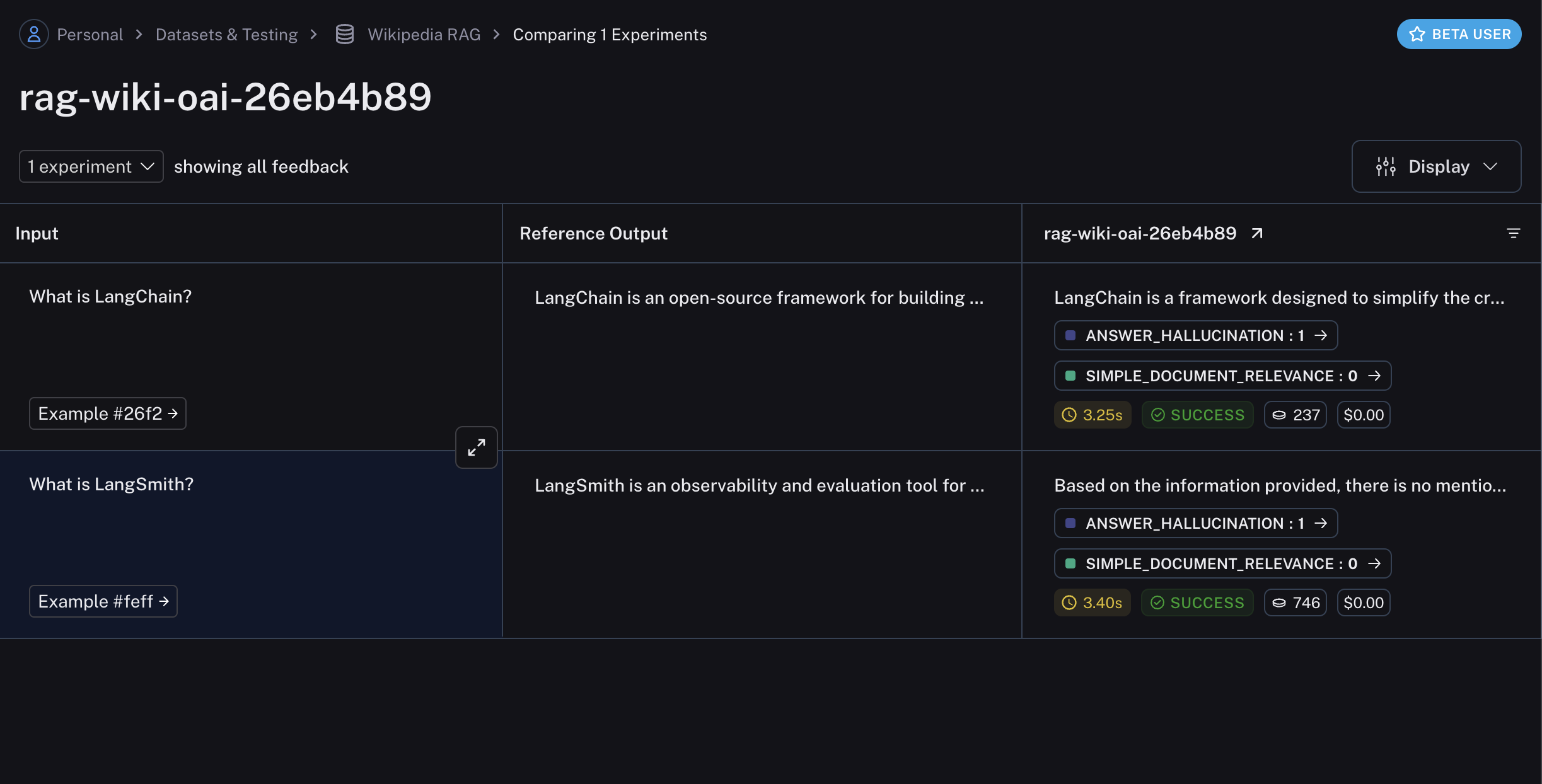
experiment_results = ls_client.evaluate(
    qa_wrapper,
    data=dataset_name,
    evaluators=[document_relevance, no_hallucination],
    experiment_prefix="rag-wiki-oai"
)
相关
以编程方式连接这些文档到 Claude、VSCode 等,通过 MCP 获取实时答案。